
Card-room exercises
Baccarat score practice
Compare completed baccarat hands, work out the last digit of each total and test how replacing one card changes the result in these Philippine card exercises.
How to read the examples
Place an imaginary dividing line between the two rows. The cards on either side belong to a single finished hand. A king, queen, jack or ten adds zero; an ace adds one. Add the marks on your own side of the line before looking across it. The last digit of each sum is all that survives on the scoreboard. A total of eighteen therefore becomes eight, and twenty becomes zero.
Look closely when a replacement takes the sum across ten. A higher card can leave a lower score. Replacing a two with a five adds three to the underlying sum, yet moving from eight to eleven changes the displayed result from eight points to one. That wrap around the end of the scale is usually easier to see if you write both the full sum and the single digit.
These are scoring puzzles about fixed cards. Some display a third card so that you can practise adding three values; the pictured order is not a simulation of the dealing procedure. Compare the two scores before the substitution, then compare them again afterwards. A tie is a complete answer. There is no need to choose a side or to put a value on any of the results.
Exercise 1: A♥, 2♠ versus Q♦, J♥
Read the two completed rows separately. The left row contains A♥, 2♠ and the right contains Q♦, J♥. Decide which side has more points. Then lift the final card of the left row and replace it with 5♠. Predict whether the comparison changes before doing the second addition.
Show the working
On the left, 1 + 2 gives 3 before discarding the tens digit. The recorded score is 3. On the right the values are 0 and 0, leaving 0 points. With these finished hands the result is the left hand.
The substitution removes 2 points of card value and adds 5. Reading the new left row, A♥, 5♠, gives 6 after the last-digit rule. The right row stays on 0, so the new comparison yields the left hand. This substitution is a scoring exercise with completed rows; it does not instruct a dealer to draw.
Exercise 2: 6♠, 3♣, 4♣ versus A♠, A♣
Read the two completed rows separately. The left row contains 6♠, 3♣, 4♣ and the right contains A♠, A♣. Decide which side has more points. Then lift the final card of the left row and replace it with 7♠. Predict whether the comparison changes before doing the second addition.
Show the working
On the left, 6 + 3 + 4 gives 13 before discarding the tens digit. The recorded score is 3. On the right the values are 1 and 1, leaving 2 points. With these finished hands the result is the left hand.
The substitution removes 4 points of card value and adds 7. Reading the new left row, 6♠, 3♣, 7♠, gives 6 after the last-digit rule. The right row stays on 2, so the new comparison yields the left hand. This substitution is a scoring exercise with completed rows; it does not instruct a dealer to draw.
Exercise 3: 6♥, K♣ versus 5♦, 3♠
Read the two completed rows separately. The left row contains 6♥, K♣ and the right contains 5♦, 3♠. Decide which side has more points. Then lift the final card of the left row and replace it with 2♦. Predict whether the comparison changes before doing the second addition.
Show the working
On the left, 6 + 0 gives 6 before discarding the tens digit. The recorded score is 6. On the right the values are 5 and 3, leaving 8 points. With these finished hands the result is the right hand.
The substitution removes 0 points of card value and adds 2. Reading the new left row, 6♥, 2♦, gives 8 after the last-digit rule. The right row stays on 8, so the new comparison yields a tie. This substitution is a scoring exercise with completed rows; it does not instruct a dealer to draw.
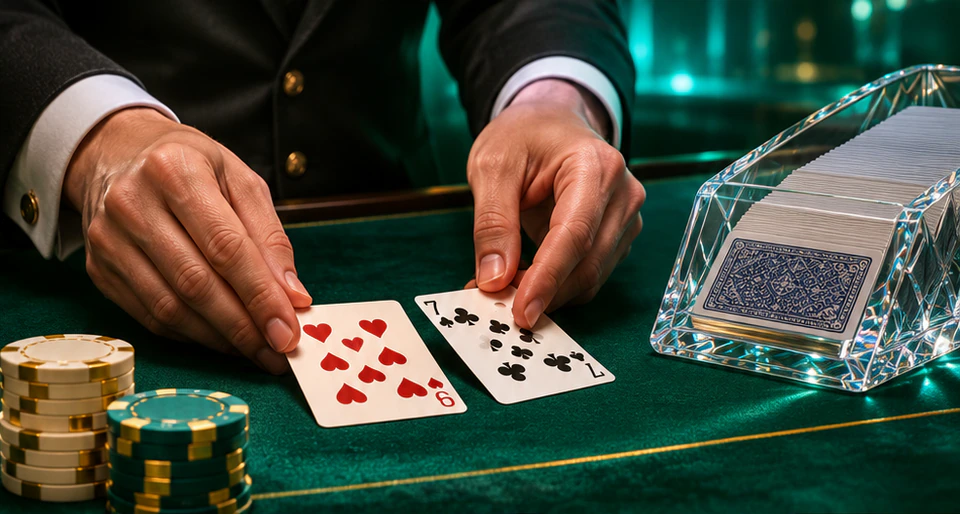
Exercise 4: 2♠, 6♥, 2♣ versus 6♠, 4♠
Read the two completed rows separately. The left row contains 2♠, 6♥, 2♣ and the right contains 6♠, 4♠. Decide which side has more points. Then lift the final card of the left row and replace it with A♥. Predict whether the comparison changes before doing the second addition.
Show the working
On the left, 2 + 6 + 2 gives 10 before discarding the tens digit. The recorded score is 0. On the right the values are 6 and 4, leaving 0 points. With these finished hands the result is a tie.
The substitution removes 2 points of card value and adds 1. Reading the new left row, 2♠, 6♥, A♥, gives 9 after the last-digit rule. The right row stays on 0, so the new comparison yields the left hand. This substitution is a scoring exercise with completed rows; it does not instruct a dealer to draw.
Exercise 5: K♣, Q♦ versus 9♥, K♦
Read the two completed rows separately. The left row contains K♣, Q♦ and the right contains 9♥, K♦. Decide which side has more points. Then lift the final card of the left row and replace it with A♦. Predict whether the comparison changes before doing the second addition.
Show the working
On the left, 0 + 0 gives 0 before discarding the tens digit. The recorded score is 0. On the right the values are 9 and 0, leaving 9 points. With these finished hands the result is the right hand.
The substitution removes 0 points of card value and adds 1. Reading the new left row, K♣, A♦, gives 1 after the last-digit rule. The right row stays on 9, so the new comparison yields the right hand. This substitution is a scoring exercise with completed rows; it does not instruct a dealer to draw.
Exercise 6: J♥, 3♦, J♠ versus 4♦, A♦
Read the two completed rows separately. The left row contains J♥, 3♦, J♠ and the right contains 4♦, A♦. Decide which side has more points. Then lift the final card of the left row and replace it with 3♣. Predict whether the comparison changes before doing the second addition.
Show the working
On the left, 0 + 3 + 0 gives 3 before discarding the tens digit. The recorded score is 3. On the right the values are 4 and 1, leaving 5 points. With these finished hands the result is the right hand.
The substitution removes 0 points of card value and adds 3. Reading the new left row, J♥, 3♦, 3♣, gives 6 after the last-digit rule. The right row stays on 5, so the new comparison yields the left hand. This substitution is a scoring exercise with completed rows; it does not instruct a dealer to draw.
Exercise 7: K♠, 4♦ versus J♣, 7♠
Read the two completed rows separately. The left row contains K♠, 4♦ and the right contains J♣, 7♠. Decide which side has more points. Then lift the final card of the left row and replace it with 5♣. Predict whether the comparison changes before doing the second addition.
Show the working
On the left, 0 + 4 gives 4 before discarding the tens digit. The recorded score is 4. On the right the values are 0 and 7, leaving 7 points. With these finished hands the result is the right hand.
The substitution removes 4 points of card value and adds 5. Reading the new left row, K♠, 5♣, gives 5 after the last-digit rule. The right row stays on 7, so the new comparison yields the right hand. This substitution is a scoring exercise with completed rows; it does not instruct a dealer to draw.
Exercise 8: 3♣, K♥, 7♦ versus J♦, 8♥
Read the two completed rows separately. The left row contains 3♣, K♥, 7♦ and the right contains J♦, 8♥. Decide which side has more points. Then lift the final card of the left row and replace it with 3♥. Predict whether the comparison changes before doing the second addition.
Show the working
On the left, 3 + 0 + 7 gives 10 before discarding the tens digit. The recorded score is 0. On the right the values are 0 and 8, leaving 8 points. With these finished hands the result is the right hand.
The substitution removes 7 points of card value and adds 3. Reading the new left row, 3♣, K♥, 3♥, gives 6 after the last-digit rule. The right row stays on 8, so the new comparison yields the right hand. This substitution is a scoring exercise with completed rows; it does not instruct a dealer to draw.
Exercise 9: 2♥, 9♣ versus A♣, 8♥
Read the two completed rows separately. The left row contains 2♥, 9♣ and the right contains A♣, 8♥. Decide which side has more points. Then lift the final card of the left row and replace it with A♦. Predict whether the comparison changes before doing the second addition.
Show the working
On the left, 2 + 9 gives 11 before discarding the tens digit. The recorded score is 1. On the right the values are 1 and 8, leaving 9 points. With these finished hands the result is the right hand.
The substitution removes 9 points of card value and adds 1. Reading the new left row, 2♥, A♦, gives 3 after the last-digit rule. The right row stays on 9, so the new comparison yields the right hand. This substitution is a scoring exercise with completed rows; it does not instruct a dealer to draw.
Exercise 10: 10♣, K♠, Q♥ versus Q♦, A♥
Read the two completed rows separately. The left row contains 10♣, K♠, Q♥ and the right contains Q♦, A♥. Decide which side has more points. Then lift the final card of the left row and replace it with 3♠. Predict whether the comparison changes before doing the second addition.
Show the working
On the left, 0 + 0 + 0 gives 0 before discarding the tens digit. The recorded score is 0. On the right the values are 0 and 1, leaving 1 points. With these finished hands the result is the right hand.
The substitution removes 0 points of card value and adds 3. Reading the new left row, 10♣, K♠, 3♠, gives 3 after the last-digit rule. The right row stays on 1, so the new comparison yields the left hand. This substitution is a scoring exercise with completed rows; it does not instruct a dealer to draw.
Exercise 11: Q♦, 7♣ versus 2♥, 8♠
Read the two completed rows separately. The left row contains Q♦, 7♣ and the right contains 2♥, 8♠. Decide which side has more points. Then lift the final card of the left row and replace it with A♣. Predict whether the comparison changes before doing the second addition.
Show the working
On the left, 0 + 7 gives 7 before discarding the tens digit. The recorded score is 7. On the right the values are 2 and 8, leaving 0 points. With these finished hands the result is the left hand.
The substitution removes 7 points of card value and adds 1. Reading the new left row, Q♦, A♣, gives 1 after the last-digit rule. The right row stays on 0, so the new comparison yields the left hand. This substitution is a scoring exercise with completed rows; it does not instruct a dealer to draw.
Exercise 12: 8♦, Q♦, 6♥ versus Q♥, 6♠
Read the two completed rows separately. The left row contains 8♦, Q♦, 6♥ and the right contains Q♥, 6♠. Decide which side has more points. Then lift the final card of the left row and replace it with Q♣. Predict whether the comparison changes before doing the second addition.
Show the working
On the left, 8 + 0 + 6 gives 14 before discarding the tens digit. The recorded score is 4. On the right the values are 0 and 6, leaving 6 points. With these finished hands the result is the right hand.
The substitution removes 6 points of card value and adds 0. Reading the new left row, 8♦, Q♦, Q♣, gives 8 after the last-digit rule. The right row stays on 6, so the new comparison yields the left hand. This substitution is a scoring exercise with completed rows; it does not instruct a dealer to draw.